What can a media container actually do?
A container is more than a filename wrapper. Depending on the format it can describe multiple media tracks, language choices, subtitles, chapters, attachments, HDR signalling, alternate edits, timecode, metadata and streaming structure.
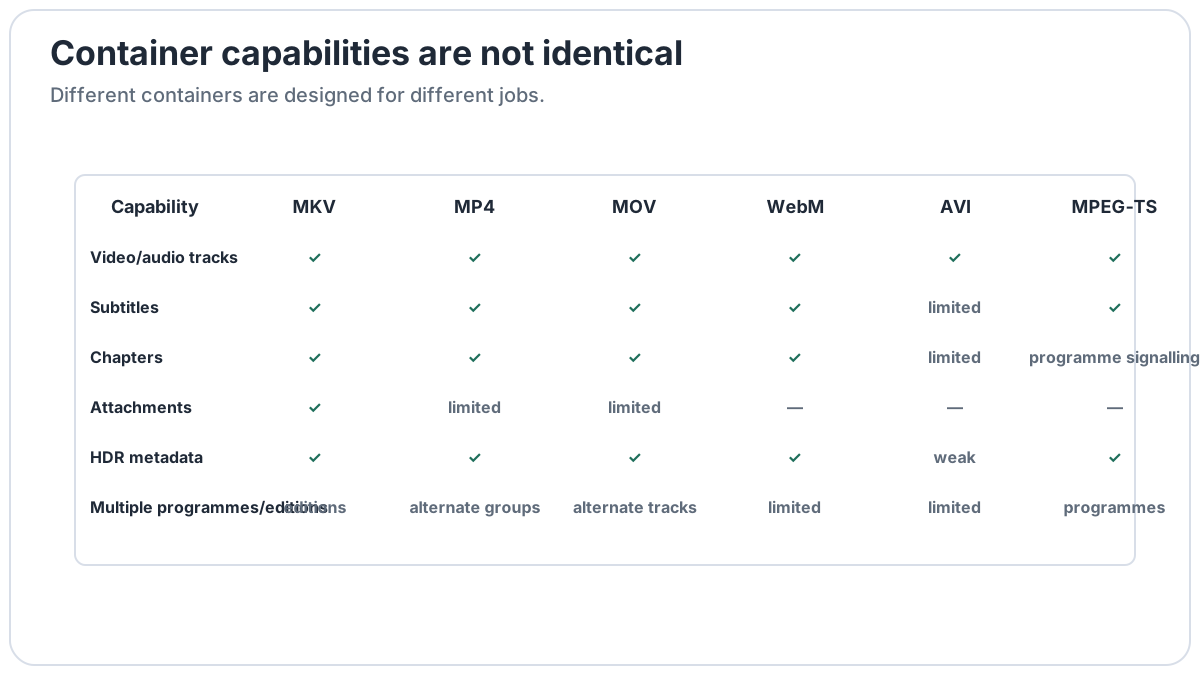
Container capability overview
| Capability | Matroska / MKV | MP4 / MOV family | WebM | AVI | Ogg | MPEG-TS | MXF |
|---|---|---|---|---|---|---|---|
| Multiple video tracks | Yes | Yes | Yes | Yes, streams | Yes, multiplexed logical streams | Yes, via PIDs/programs | Yes |
| Multiple audio tracks / languages | Yes, rich track flags | Yes, alternate groups | Yes | Yes, but basic signalling | Possible; structure metadata is separate | Yes | Yes |
| Subtitle / caption tracks | Yes, text and image mappings | Yes | Yes, constrained by WebM profile/player | Possible but inconsistent/legacy | Possible through codec mappings | Yes, broadcast/DVD/Blu-ray systems | Yes |
| Chapters | Yes, including multiple/ordered editions | Supported by ecosystem conventions/metadata | Basic Matroska chapter elements supported | Not a strong native feature | Not core Ogg; external mappings can add structure | Program/service structures rather than file-style chapters | Production metadata rather than consumer chapters |
| Attachments / cover art / fonts | Yes, general attachments | Artwork/metadata supported; arbitrary attachments are not the same model | Matroska attachments intentionally unsupported by WebM guidelines | RIFF chunks can carry extra data, but no comparable universal attachment model | Not a core attachment system | Not a general file-attachment model | Can carry rich metadata and associated essence/data |
| Alternate edits / editions | Yes, multiple editions and ordered chapters | Alternate tracks/groups; edit lists and movie structures | Subset only | Limited | Not a core feature | Programs/services can provide alternate selections | Strong editorial/version metadata in professional workflows |
| 3D / stereo video signalling | Yes, explicit stereo modes and multi-plane track operations | Possible through sample entries/metadata/profile-specific signalling | Some Matroska stereo elements are supported | Mostly codec/private conventions | Codec/mapping dependent | System/profile dependent | Professional metadata/profile dependent |
| HDR / mastering metadata | Yes, colour/mastering metadata; Dolby Vision mappings exist | Yes, widely used for HDR10/HLG/Dolby Vision signalling | Yes for supported video mappings | Weak container-level HDR model | Codec/mapping dependent | Yes in modern broadcast/video systems | Yes in professional interchange profiles |
| Streaming orientation | File/stream capable | Strong fragmented/streaming variants | Designed for web delivery | Primarily file-oriented | Strong one-pass stream orientation | Excellent for continuous transport/broadcast | Professional file/interchange orientation |
| Rich technical/production metadata | Yes | Yes | Reduced subset | Limited/legacy | Basic at core; Skeleton can add stream metadata | Service/program metadata | Excellent; a core MXF strength |
This table is intentionally about representational capability. Exact codec combinations and device support still depend on the relevant profile, mapping and implementation.
Why Matroska looks unusually broad
Matroska was designed as an extensible container rather than around one delivery ecosystem. It has first-class structures for multiple tracks, selectable roles/languages, chapters, multiple editions, arbitrary attachments, tags, stereo-3D modes, projections/VR metadata, colour/mastering metadata and track operations.
This makes MKV attractive for local libraries and preservation-style packaging, where one file might contain the main video, several audio mixes, commentary, descriptive audio, forced and full subtitles, chapter structures, cover art and subtitle fonts.
Capability does not guarantee playback support
A television can support “MKV” while supporting only a narrow subset of what Matroska can contain. The same applies to MP4, MOV, WebM and MXF. A useful compatibility check therefore asks at least three questions:
- Can the application parse the container?
- Can it decode the codec/profile/bit depth of each needed track?
- Does it understand the specific container feature, such as Dolby Vision signalling, PGS subtitles, ordered chapters or multiple editions?
Do not confuse capability with media quality
A container that supports more features does not inherently produce better picture or sound. Remuxing the same H.265 video and TrueHD audio between compatible containers can leave the encoded media unchanged while changing only packaging and metadata.