DAC architectures explained
“16-bit”, “20-bit”, “1-bit”, “32-bit”, R2R and delta-sigma can all describe real DAC designs, but they do not all describe the same thing. DAC history is a progression of different ways to solve reconstruction, linearity and filtering problems.
The simple answer
A DAC turns numerical audio samples into an analogue signal. Designers can do that with a multibit resistor network, a very fast low-bit modulator, a hybrid of the two, or separate conversion paths for different source formats.
Multibit
Represents many amplitude levels directly. Classic 16-, 18- and 20-bit DACs belong to this family.
1-bit / low-bit
Trades amplitude resolution for a much higher internal rate and noise shaping.
Hybrid
Combines multibit and delta-sigma ideas, or uses different conversion behaviour for PCM and DSD.
Architecture is not the same as source bit depth
A 16-bit CD can be played through an 18-bit, 20-bit, 24-bit or internally higher-precision DAC. The extra converter or processing precision does not create new information in the CD, but it can provide room for interpolation, filtering, volume control and conversion errors below the source's nominal 16-bit level.
Likewise, a DAC advertised as “32-bit” is not claiming that the analogue output physically resolves 32 perfect bits. The number may describe accepted PCM word length, digital processing precision, accumulator width, or an internal conversion stage.
A simplified historical progression
| Era / approach | Typical idea | Main engineering goal |
|---|---|---|
| Early multibit | 14- or 16-bit converters, initially with little or modest digital oversampling | Accurate analogue levels from the PCM sample words |
| Oversampling multibit | 16-bit conversion with 4×, 8×, 16× or other interpolation rates | Move image rejection farther from the audio band and ease analogue filtering |
| 18- and 20-bit multibit | More internal amplitude resolution than the 16-bit CD source | Improve low-level linearity and processing headroom |
| 1-bit Bitstream | Heavy oversampling plus noise shaping into a two-level converter | Avoid multibit level-matching errors and simplify the final conversion element |
| Low-bit / multilevel delta-sigma | Several internal output levels rather than a strict two-level stream | Retain noise-shaping advantages while reducing some pure 1-bit compromises |
| Modern NOS / R2R revival | Multibit ladders, sometimes with selectable or no digital interpolation | Alternative reconstruction philosophy and direct multibit conversion |
| PCM / DSD hybrid designs | Shared hardware in different modes, or separate paths for PCM and DSD | Handle fundamentally different input representations without one mandatory conversion path |
The CD format stayed the same while playback technology changed
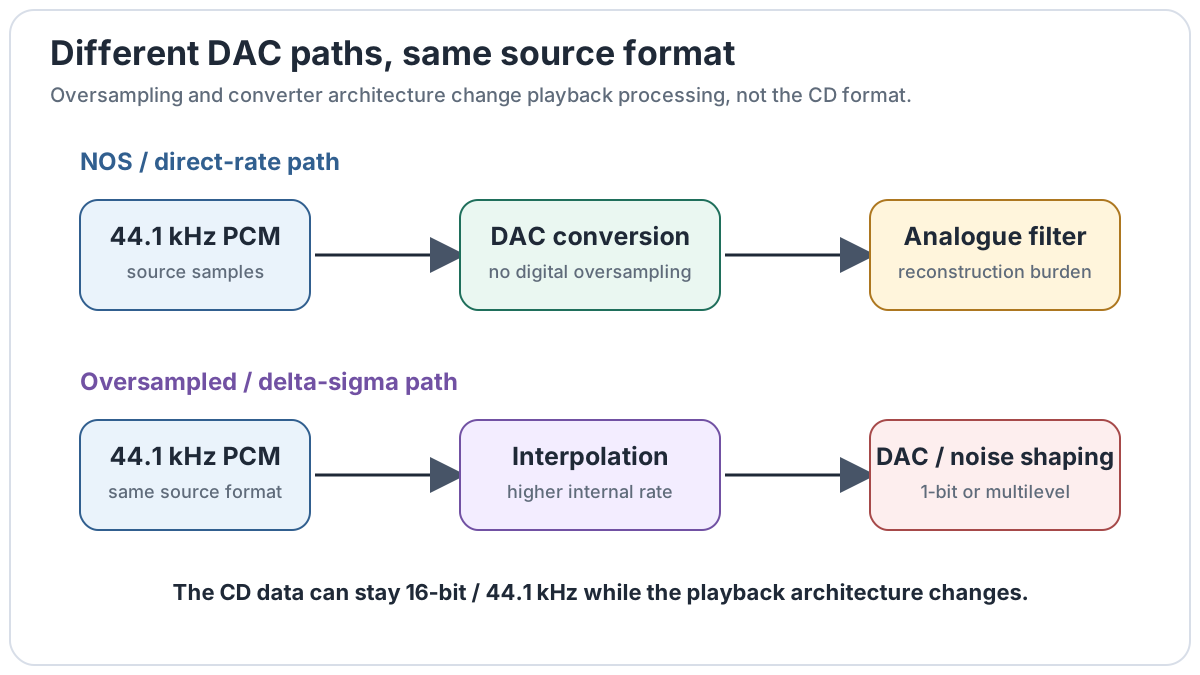
This is one of the most important points in the history of digital playback. The Compact Disc format did not keep gaining bits or sample rate as DAC design evolved. Standard audio CD remained 16-bit / 44.1 kHz PCM.
What changed was the playback chain after those samples were read from the disc. Manufacturers experimented with different digital filters, oversampling ratios, interpolation methods, converter resolutions, noise-shaping systems, analogue reconstruction filters and output stages.
| What stayed fixed on the CD | What could change inside the player |
|---|---|
| 16-bit PCM samples | 16-, 18-, 20-, 24-bit or internally higher-precision processing and conversion |
| 44.1 kHz sample rate | NOS, 4×, 8×, 16×, 64×, 256× or other internal oversampling strategies |
| The same programme data | Multibit ladder, 1-bit Bitstream, low-bit delta-sigma, hybrid or other DAC architectures |
Key idea: the format did not evolve with the DAC; the playback architecture did. A newer player could process the same 16-bit / 44.1 kHz CD very differently without the disc containing any extra source information.
High-oversampling multibit was a real design path
Oversampling did not arrive only with 1-bit DACs. Classic CD players already used digital interpolation with conventional multibit conversion. One well-known example, the Cambridge Audio CD2, was promoted as a 16-bit, 16× oversampling player.
The important point is that source precision and oversampling factor describe different things. A 16-bit / 44.1 kHz source can remain 16-bit programme material while the player mathematically interpolates it to a much higher internal sample rate before conversion.
Common confusion: “16-bit DAC” does not mean “no oversampling”, and a higher oversampling factor does not change a CD into a higher-resolution recording.
Why 1-bit DACs went in the opposite direction
A pure 1-bit converter has only two instantaneous output states. Instead of relying on many precisely matched analogue amplitude levels, it uses a very high switching rate and noise shaping so the time-average output represents the wanted waveform.
Philips Bitstream is a classic example. Some implementations converted 44.1 kHz PCM into a 1-bit stream at 256× the CD sample rate: 11.2896 MHz.
This approach became associated with a “smooth” or “less digital” presentation in period hi-fi discussion. That is a subjective reputation, not a guaranteed acoustic property. Filter design, noise shaping, analogue stages and the rest of the player remain important.
Most modern delta-sigma DACs are not simply old-fashioned 1-bit DACs
Modern delta-sigma converters commonly use low-bit or multilevel internal DAC elements rather than a single two-level output. This can reduce the ultrasonic noise and stability demands of a pure 1-bit modulator while still benefiting from heavy oversampling and noise shaping.
That is why the modern market can contain devices described as 24-bit or 32-bit DACs even though their final internal conversion architecture may be delta-sigma and use far fewer analogue levels than the incoming PCM word length.
A DAC supporting DSD does not tell you how it converts DSD
“DSD support” describes compatibility, not necessarily one conversion architecture. A product may:
- convert DSD to PCM internally;
- keep DSD in a low-bit noise-shaped path;
- use a different operating mode in the same converter;
- or use genuinely separate PCM and DSD conversion paths.
This matters when comparing products advertised as “native DSD”. The phrase may describe the digital path, the physical conversion path, or both, depending on the manufacturer.
What does “32-bit DAC” really mean?
| Claim on a specification sheet | What it may actually mean |
|---|---|
| 16-bit DAC | Classic converter resolution, often used with oversampling on CD players |
| 18- or 20-bit DAC | Greater internal multibit resolution or low-level linearity than the 16-bit source |
| 24-bit DAC | Usually accepts 24-bit PCM and may process at that precision or higher |
| 32-bit DAC | Often input/processing capability; it should not be read as 32 bits of real analogue resolution |
| 1-bit DAC | A high-rate two-level conversion architecture, not “one bit of audio quality” |
Common confusion
Bit depth, oversampling rate and DAC architecture are separate properties. A 16-bit recording can be oversampled hundreds of times; a “32-bit DAC” may use a low-bit delta-sigma output stage; and a 1-bit DAC can achieve high effective dynamic range through a very high rate and noise shaping.
NOS does not mean no reconstruction
A non-oversampling DAC still requires analogue reconstruction and filtering. NOS means that it does not first create a higher-rate interpolated digital stream.
Oversampling does not recover missing information
Interpolation can make filtering and conversion easier, but it does not add musical information that was absent from the source samples.
More bits on the box do not automatically mean better sound
Architecture, clocking, filtering, analogue output design, power supply and implementation can matter more than the headline number.
Frequently asked questions
Why did some CD players use 18- or 20-bit DACs for 16-bit CDs?
Extra internal precision can improve low-level linearity and provide headroom for interpolation, filtering and digital processing. It does not turn the original CD samples into a true 18- or 20-bit recording.
Is a 1-bit DAC the same as DSD?
No. They are related ideas because both can use very high-rate low-bit streams, but a DAC architecture and an audio storage format are different layers. A 1-bit DAC can convert PCM after internal modulation, while DSD is a source representation.
Are modern DACs really 32-bit?
They may accept or process 32-bit PCM, but the analogue output does not provide 32 perfect bits of real-world resolution. Treat “32-bit” as a digital capability specification unless the manufacturer defines it more precisely.