Preserving HDCD without losing its control data
HDCD information is embedded in the 16-bit PCM stream, so the safest master keeps that original PCM unchanged.
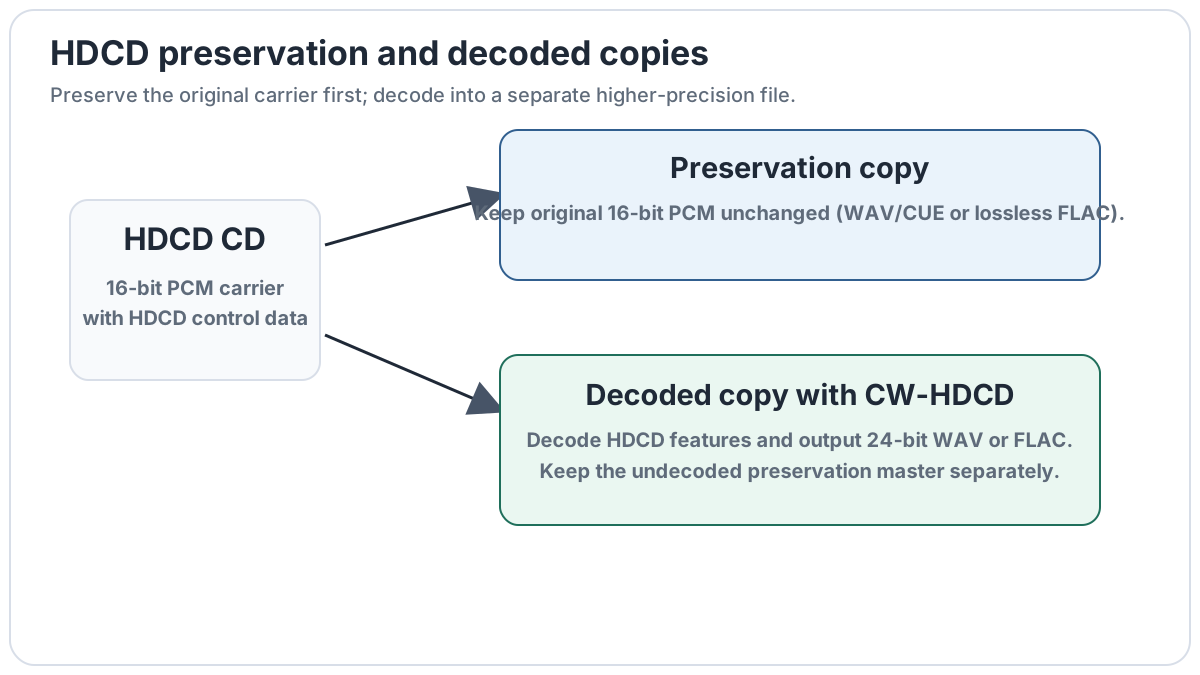
HDCD is embedded in PCM
An HDCD disc is still an audio CD carrying 16-bit / 44.1 kHz PCM. HDCD-compatible control codes are embedded in that PCM stream. A decoder can interpret features such as Peak Extend and Low-level Gain Adjustment and expand the result into a higher-precision PCM representation.
Why WAV/CUE fits
A secure WAV/CUE image is a straightforward way to preserve the original CD PCM and disc layout together. Because the PCM has not been decoded or altered, the HDCD control information remains available for later detection and decoding.
FLAC can preserve it too
WAV is not uniquely required. Lossless FLAC preserves the original PCM samples and can therefore retain HDCD data as well. FFmpeg's HDCD decoder explicitly accepts both HDCD-bearing WAV and FLAC input. The preservation requirement is sample accuracy, not a specific filename extension.
Decoded HDCD is a derivative
Once HDCD is decoded, Peak Extend or gain information may be applied and the output is commonly stored in 24-bit PCM so the expanded signal is not truncated. That decoded file is useful for playback, but it is no longer the untouched 16-bit HDCD carrier. Keeping the original rip leaves both options open.
What can break detection
Sample-altering processing can destroy or disturb the embedded control stream. Avoid normalization, resampling, lossy encoding and other DSP on the preservation master if future HDCD detection matters.