GOPs, I-frames, P-frames, B-frames and keyframes
Modern video codecs save large amounts of data by storing some pictures relative to other pictures. A GOP—group of pictures—describes a run of coded pictures organised around independently decodable or reference pictures.
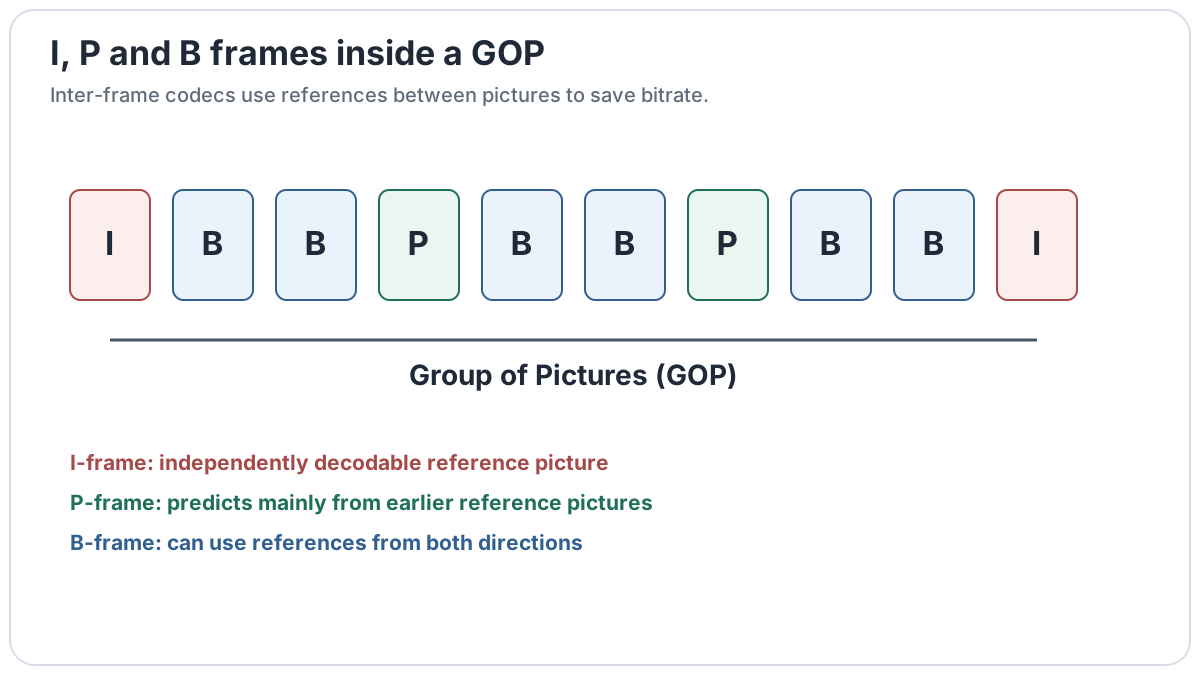
I, P and B pictures
| Type | General idea | Typical effect |
|---|---|---|
| I / intra picture | Coded primarily from information within that picture. | Larger but provides a natural random-access/reference point. |
| P / predictive picture | Can predict from earlier reference pictures. | Usually smaller than equivalent intra pictures. |
| B / bi-predictive picture | Can use reference pictures from both temporal directions, depending on codec structure. | Can improve compression efficiency but complicates decode/display order. |
Modern standards are more nuanced than the old MPEG shorthand, but I/P/B remains a useful mental model.
What is a GOP?
A GOP groups pictures into a prediction structure. A short GOP inserts random-access points more frequently; a long GOP can improve compression efficiency by exploiting similarity across more pictures.
Streaming encoders often choose GOP/keyframe intervals to balance compression, channel switching, adaptive-streaming segment boundaries and seek responsiveness.
Why keyframes matter for seeking and editing
If playback starts on a picture that depends on earlier reference pictures, a decoder may need to begin from an earlier random-access point and decode forward. That is why a seek can land slightly before the requested frame or take longer in heavily inter-frame-compressed media.
Frame-accurate editing can also require decoding neighbouring frames even if only one visible frame is being changed.
All-I versus long-GOP
| Approach | Strength | Trade-off | Examples |
|---|---|---|---|
| All-I / intraframe | Easy random access and editing | Higher bitrate for similar visual quality | Many ProRes modes, some AVC-Intra/DNx workflows |
| Long-GOP / interframe | High compression efficiency | More dependency between pictures | H.264, HEVC, AV1 delivery and camera modes |
Common confusion
Its importance is that it provides a decoding/random-access boundary.
They are compression tools. Their value depends on codec, encoder and use case.
Every picture can still be heavily spatially compressed.