Video colour: RGB, YCbCr, range, primaries and HDR signalling
A video stream can describe colour with several independent fields. Bit depth and chroma subsampling are only part of the picture: colour primaries, transfer characteristics, matrix coefficients and range tell a decoder how stored values should be interpreted.
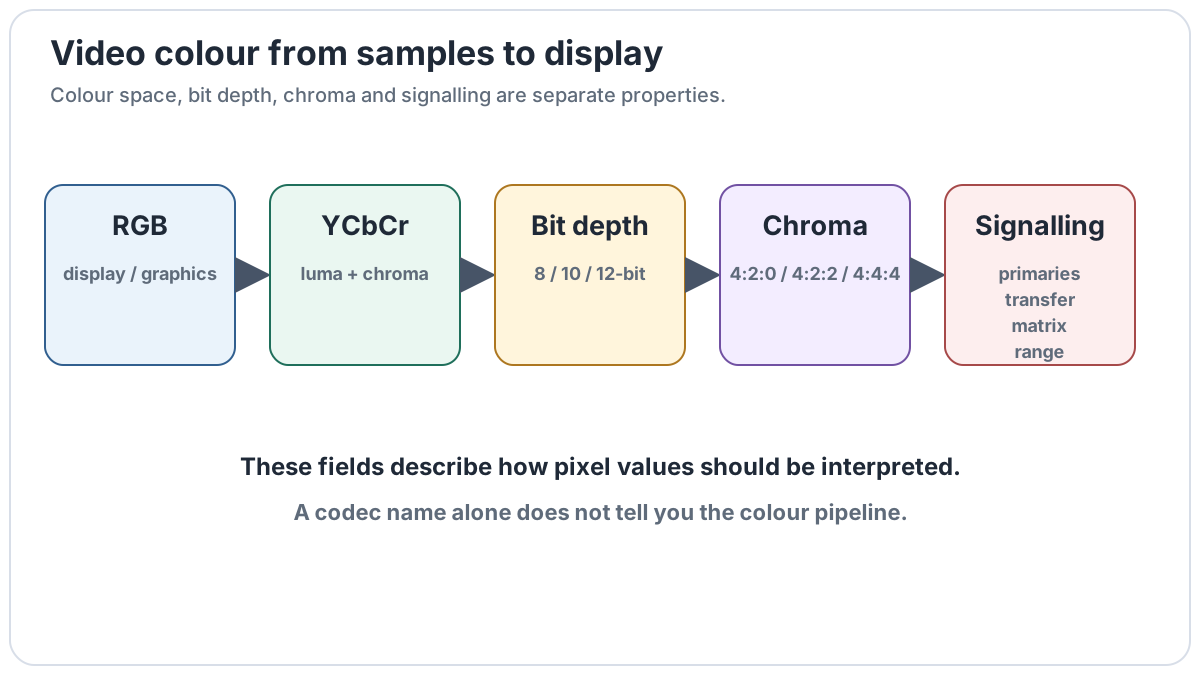
The main colour descriptors
| Field | What it describes | Examples |
|---|---|---|
| Bit depth | Numeric precision per component | 8, 10, 12 bit |
| Chroma subsampling | Spatial resolution of colour-difference channels | 4:2:0, 4:2:2, 4:4:4 |
| Colour primaries | Chromaticities defining the RGB colour gamut | BT.601, BT.709, BT.2020 |
| Transfer characteristics | Relationship between encoded signal and light/display response | BT.709-style transfer, PQ/ST 2084, HLG |
| Matrix coefficients | How RGB-related signals are converted to/from luma/chroma components | BT.601, BT.709, BT.2020 matrices |
| Range | Which code values represent black/white and headroom | Limited/video range, full range |
RGB versus YCbCr
RGB stores red, green and blue components directly. Most compressed consumer video instead works with YCbCr: a luma-like Y′ component plus two colour-difference components. YCbCr makes chroma subsampling practical because human vision is generally less sensitive to fine chroma detail than fine luma detail.
The word YUV is often used casually for digital YCbCr, especially in software and pixel-format names, but technically YUV and digital YCbCr are not identical concepts.
Full versus limited range
Video-range signalling normally reserves code values outside the nominal black-to-white interval, while full range uses a wider numeric span for active picture values. The exact code values depend on bit depth and standard.
A range mismatch can make a picture look washed out or crushed even though the encoded pixels themselves are otherwise valid.
BT.601, BT.709 and BT.2020 are not just “resolutions”
| Family | Common association | Important note |
|---|---|---|
| BT.601 | SD digital television | Defines colour-related parameters used by SD workflows. |
| BT.709 | HD television | Widely used for SDR HD video. |
| BT.2020 | UHD television | Defines a much wider colour gamut and UHD production parameters; HDR may use BT.2020 primaries with PQ or HLG transfer signalling. |
HDR is another layer
HDR commonly combines higher bit depth with a wider colour gamut and an HDR transfer characteristic such as PQ or HLG. Static or dynamic metadata may add mastering/display guidance, but HDR is not itself a video codec.
HEVC, AV1 and other codecs can carry HDR video when the relevant profile and signalling are supported.
Common confusion
The informal label is widespread, but the distinction matters when discussing colour science precisely.
BT.2020 primaries can be used independently of an HDR transfer function.
10-bit SDR is possible, and HDR depends on transfer/gamut signalling as well as precision.